

Arizona AI Summit Explores the Future of Work and Learning
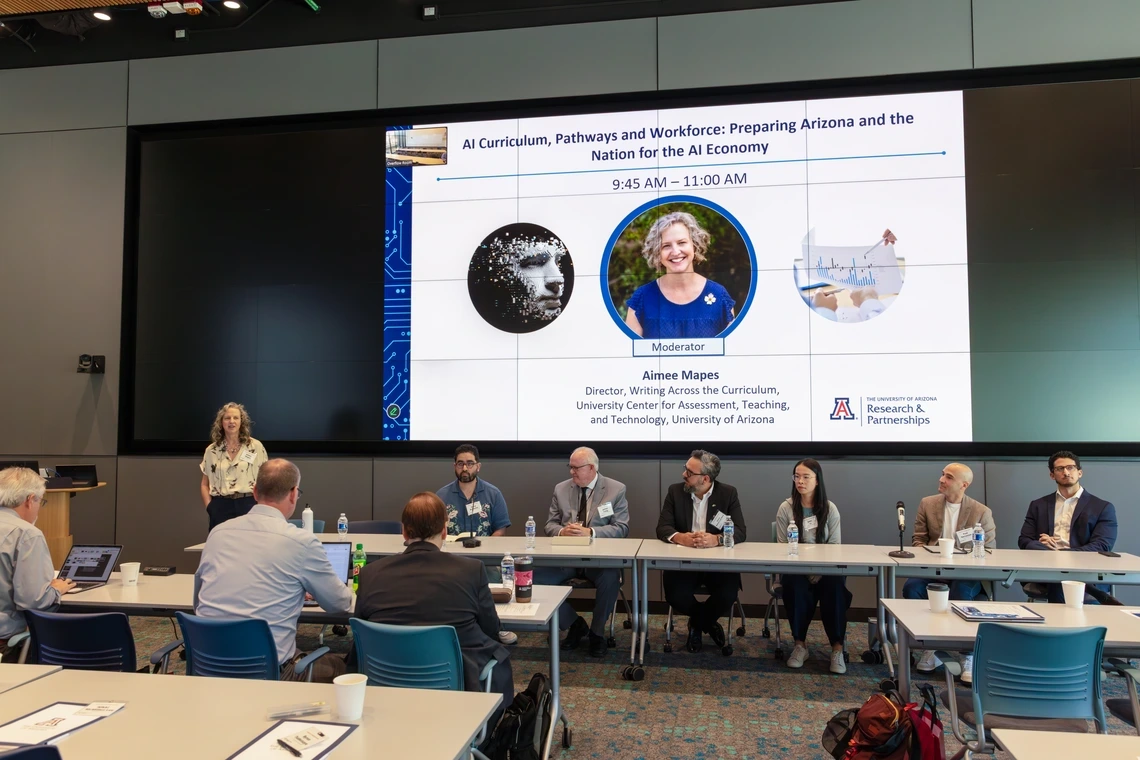
The landscape of higher education is shifting beneath our feet, and once again, we find ourselves at the precipice of a new industrial era. On March 18, 2026, the Grand Challenges Research Building hosted 160 leaders for the Arizona AI Leadership Summit, a gathering to bridge the gap between academic research and state, federal, and community initiatives.
A highlight of the event was the panel “AI Curriculum, Pathways, and Workforce,” moderated by University of Arizona WAC Director, Aimee Mapes. The session brought together leaders in higher education, public health, industry, and government data scientists to tackle a singular question: How do we redesign our educational architecture for an AI-driven economy?
A New "Industrial Revolution"
Dr. Mapes opened the dialogue with a striking historical parallel. She compared the current AI surge to the Industrial Revolution of the late 19th century.
Just as the Morrill Acts of 1862 and 1890 broke the closed circuit of elite private education to create land-grant institutions like the University of Arizona, the AI wave demands a similar pivot toward public access and practical, community-driven problem-solving. The discussion featured voices from across the regional ecosystem, including:
- Mario Banuelos (Associate Professor, CSU Fresno, Mathematics)
- Jim Craig (Dean, Pima Community College, Business & IT)
- Onicio B. Leal-Neto (Associate Research Professor, U of A, Public Health)
- Jialu Li (Assistant Professor, U of A, Information Science)
- Paul Nersesian (Master Electronics Learning & Talent Development Manager)
- Ferris Ramadan (Data Scientist & Data System Director, Arizona Office of Economic Opportunity)
The panelists identified several critical themes that will define the next decade of AI literacy:
- Redefining Literacy: AI literacy is no longer an elective; it is a core learning outcome across all disciplines.
- The Skills Evolution: AI is reshaping what skill looks like, requiring a focus on attribution, ethical use, and human-in-the-loop verification.
- Workforce Transitions: Industry partners emphasized the urgent need to reskill workers and define realistic career pathways as traditional roles evolve.
- Equity and Health: Experts noted that information is a determinant of health, warning that AI-mediated information could deepen existing inequities if not carefully managed.
Why WAC Matters in the AI Era
As both a pedagogy and a scholarly discipline, Writing Across the Curriculum (WAC) is uniquely positioned to lead this transition. Because WAC views writing and AI as a set of social practices that vary by field, it provides an adept framework for thinking about AI not just as a tool, but as a diverse set of literacies tailored to specific industries.
The summit made one thing clear: We are redesigning our social and educational world in real time. By leaning into the land-grant mission of accessibility and practical application, we can ensure the AI economy serves the many, not just the few.
Wanna know more about AI and WAC? Learn more on our AI page.

Aimee Mapes, University of Arizona WAC Director, stands at a podium to address, "What should stakeholders in education, communities, and industry understand about preparing learners and professionals in the emerging AI economy?"

A wide-angle view of the Grand Challenges Research Building lecture hall, filled with summit attendees. The main screen introduces the diverse panel of experts from mathematics, community college leadership, public health, information science, and the Arizona Office of Economic Opportunity.

The expert panel engages in discussion seated beneath a detailed infographic titled "The New Assessment Stack." The slide illustrates the cultural shift in higher education.